

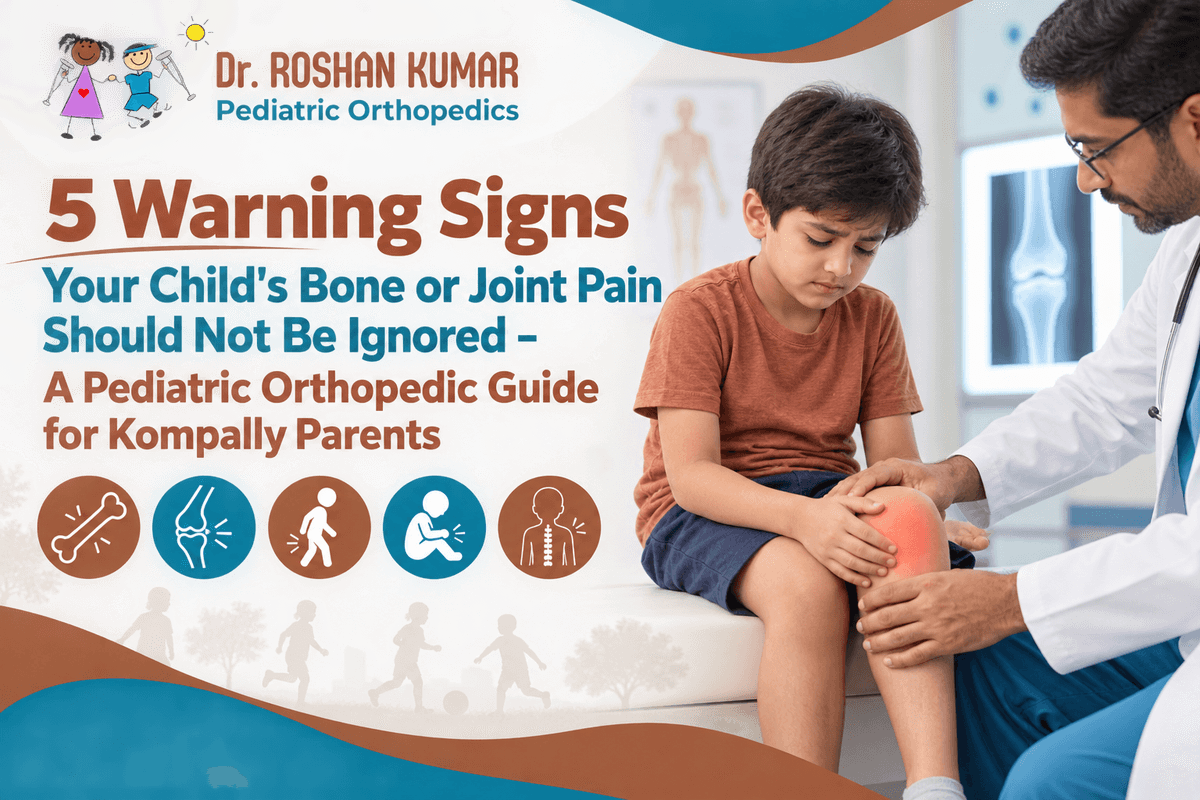
5 Warning Signs Your Child's Bone or Joint Pain Should Not Be Ignored – A Pediatric Orthopedic Guide for Kompally Parents
Is Your Child's Pain Just Growing Pains — or Something More?
Every parent in Kompally has been there. Your child comes home limping after school, rubbing a knee before bedtime, or waking up in the middle of the night crying about leg pain. Your first instinct is to reassure them: "It's just growing pains. You'll be fine by morning."
And often, you're right. Bone and joint pain in children is common, and many cases are linked to temporary, non-serious causes. But not always.
Children are not simply small adults. Their bones are still growing, their joints may be more flexible, and their symptoms can be subtle. This means that warning signs can be easy to miss — and easy to dismiss. Knowing which signals demand a proper clinical evaluation, and which ones can be safely monitored at home, is knowledge every parent deserves.
This guide from Dr. Roshan Kumar Jaiswal, Pediatric Orthopedic Surgeon, is designed to help Kompally parents tell the difference.
What's the Direct Answer? When Should You Be Concerned?
Medical advice is recommended if bone or joint pain lasts more than a few days, keeps coming back, or affects a child's usual activities.
The key difference between growing pains and something more serious is that true growing pains don't localize to a specific joint or bone, and they don't cause a limp.
Concerning red-flag signs and symptoms for joint pain include ill appearance, spiking fevers, pinpoint bony tenderness, nocturnal bone pain, unexplained bruising, and inability to bear weight.
If your child is showing any of these signs, a Pediatric Orthopedic Surgeon in Kompally should assess them — not because every case is serious, but because a clinical examination is the only reliable way to know.
5 Warning Signs That Should Never Be Ignored
⚠️ Warning Sign 1: Pain That Wakes Your Child From Sleep
Night pain is one of the most important red flags in pediatric orthopedics. Warning signs include fever, tiredness, loss of appetite, weight loss, easy bruising, or pain that wakes a child frequently from sleep.
Bone pain is generally less common but can be intense and sharply localised. When a child is roused from sleep by bone pain, it warrants prompt evaluation to rule out infection, inflammatory conditions, or — in rare cases — other underlying causes.
Do not wait to see if this resolves on its own. Night pain that recurs is a clinical red flag.
⚠️ Warning Sign 2: A Limp or Sudden Refusal to Walk
If your child suddenly starts limping or avoids putting weight on one leg, it's a red flag. This could indicate injury, infection, or joint inflammation.
A child with fever, severe joint pain, swelling, and inability to bear weight should be seen quickly. Prompt evaluation is especially important if the child has a limp, cannot bear weight, has joint swelling, or seems unusually tired or unwell.
A limp is never a normal finding. Even when it appears minor or comes and goes, it deserves a proper clinical examination — especially in younger children who may not be able to describe where it hurts.
⚠️ Warning Sign 3: Joint Swelling, Warmth, or Morning Stiffness
Swelling in knees, ankles, or elbows is not normal. It often points to inflammation or injury that requires medical attention.
A joint effusion is never normal and warrants further evaluation.
Morning stiffness that improves through the day is a characteristic pattern worth noting. Symptoms of Juvenile Idiopathic Arthritis (JIA) vary depending on the type, but all forms share persistent joint pain, swelling, warmth, and stiffness that are typically worse in the morning and after a nap or prolonged sitting.
Early intervention can help manage JIA and prevent joint damage. If your child is consistently stiff in the morning and seems to "loosen up" through the day, this pattern should be discussed with a pediatric orthopedic specialist.
⚠️ Warning Sign 4: Pain Directly Over a Bone or Near a Joint After an Injury
Tenderness directly over a bone rather than in the muscle is a sign that warrants specialist evaluation.
This matters enormously in growing children because of growth plates — the soft cartilage zones at the ends of long bones. Because the cartilage of the growth plate is softer and less dense than surrounding bone, it is more prone to injury. The physis is often weaker than the ligaments that connect bones, meaning a force that might sprain an adult's joint can actually fracture a child's growth plate instead.
Because the growth plate directs how a bone continues to lengthen and align, an injury here is treated as an orthopedic priority, not a routine bump. If a growth plate injury is missed or managed incorrectly, it can affect how the bone grows afterward, potentially leading to a limb that grows unevenly or at an angle.
Prompt treatment by an orthopedic specialist — ideally within 5 to 7 days of injury — is crucial, as the growth plate begins healing quickly and can complicate correction if delayed.
⚠️ Warning Sign 5: Fever Alongside Bone or Joint Pain
Fever with bone or joint pain can be a sign of infection and should be assessed quickly.
Septic arthritis should always be suspected in any young child with a new-onset painful joint, especially when associated with local inflammatory signs. This is a condition that requires urgent care — delay can lead to joint damage.
Systemic symptoms like unexplained weight loss, rash, or lethargy can indicate more serious underlying conditions and should always be mentioned to your doctor.
How Dr. Roshan Kumar Jaiswal Approaches Pediatric Bone and Joint Concerns
Dr. Roshan Kumar Jaiswal is a Pediatric Orthopedic Surgeon serving families across Kompally and surrounding areas. His approach to evaluating a child's bone or joint complaint is structured and child-focused.
The evaluation begins with a thorough history, including the timeline of symptoms, recent illnesses or injuries, and any changes in activity or behaviour. A focused physical exam follows, assessing gait, posture, joint movement, strength, and tenderness.
Where necessary, imaging or laboratory investigations are arranged to build a complete clinical picture. If there are red flags, the doctor may order blood tests to look for inflammation, infection, anaemia, or other abnormalities.
The goal is accurate diagnosis — so that the management plan is based on what your child actually has, not what it might be assumed to be.
Clinical Context: Why Pediatric Orthopedics Is a Distinct Specialty
Pediatric orthopedic surgeons specifically train to evaluate and treat children with bone conditions or fractures. This training matters because children's musculoskeletal systems behave differently from adults'.
Untreated or mismanaged growth plate injuries can result in uneven bone growth, limb length differences, or angular deformity. This is why pediatric orthopedic evaluation is so important when a child injures a limb near a joint.
Bone and joint pain in children can also result from injury, overuse, infection, inflammation, vitamin deficiency, or less commonly, more serious disease. Identifying the precise cause requires a clinician trained in the full spectrum of paediatric musculoskeletal conditions.
Recognising the difference between normal growth-related discomfort and a potential orthopedic condition can help parents seek treatment before the problem affects a child's mobility or development.
Frequently Asked Questions (FAQ)
Q1: How do I know if my child's pain is growing pains or something more serious?
Mild soreness after a hard practice or general leg achiness in a rapidly growing child may fall into the category commonly called growing pains. The key difference is that true growing pains don't localise to a specific joint or bone, and they don't cause a limp. If pain is consistent in one location, worsens over days, or is accompanied by swelling or fever, it needs clinical evaluation.
Q2: At what age do children's growth plates close?
Growth plates disappear when a child reaches maturity (or has fully grown), but they are the last portion of children's bones to harden, which is why they're so susceptible to injury during the growth process. Boys are at higher risk for longer because it takes boys more time to finish growing. Until growth plates close, any injury near a joint deserves careful evaluation.
Q3: My child in Kompally plays cricket and football regularly. Can sport cause bone injury?
Yes. Year-round play in a single sport, back-to-back seasons, and participation across several teams leave young joints little time to recover. Pain that shows up during or after every practice, slowly gets worse, or changes the way a child throws, runs, or lands is the body signalling something is wrong. Children who train regularly should be assessed if pain is recurring or persistent, rather than waiting for the season to end.
Q4: What is Juvenile Idiopathic Arthritis, and can my child develop it?
Juvenile Idiopathic Arthritis (JIA) is a form of arthritis in children ages 16 or younger that causes inflammation and stiffness of joints for more than six weeks. Children with JIA often present with stiffness, sometimes accompanied by a mild limp in the mornings, which becomes less apparent later in the day. It is not caused by sport or injury — it is an inflammatory condition that requires specific medical management.
Q5: When does bone or joint pain in a child require emergency care?
Urgent assessment is recommended for severe pain, obvious deformity, inability to use a limb, sudden refusal to walk, high fever with joint pain, or swelling after injury. Urgent assessment is also needed if the child has fever, a hot or swollen joint, severe pain, inability to walk, or rapid worsening of symptoms. In such situations, do not delay seeking medical attention.
Visit Us
For appointments or more information about Dr Roshan Kumar Jaiswal, please use the contact details below.
Dr Roshan Kumar Jaiswal
Kompally
Phone: +919542904584
Website: www.drroshanchildortho.com/
Google Maps: https://www.google.com/maps/place/?q=place_id:ChIJO7gwI0CZyzsRTxp9wAaOdWI
Email: jaiswal_roshan02@yahoo.co.in
Disclosure: This article was prepared with the assistance of artificial intelligence and reviewed by the clinic. It is for general information only and is not a substitute for professional medical advice, diagnosis or treatment.