

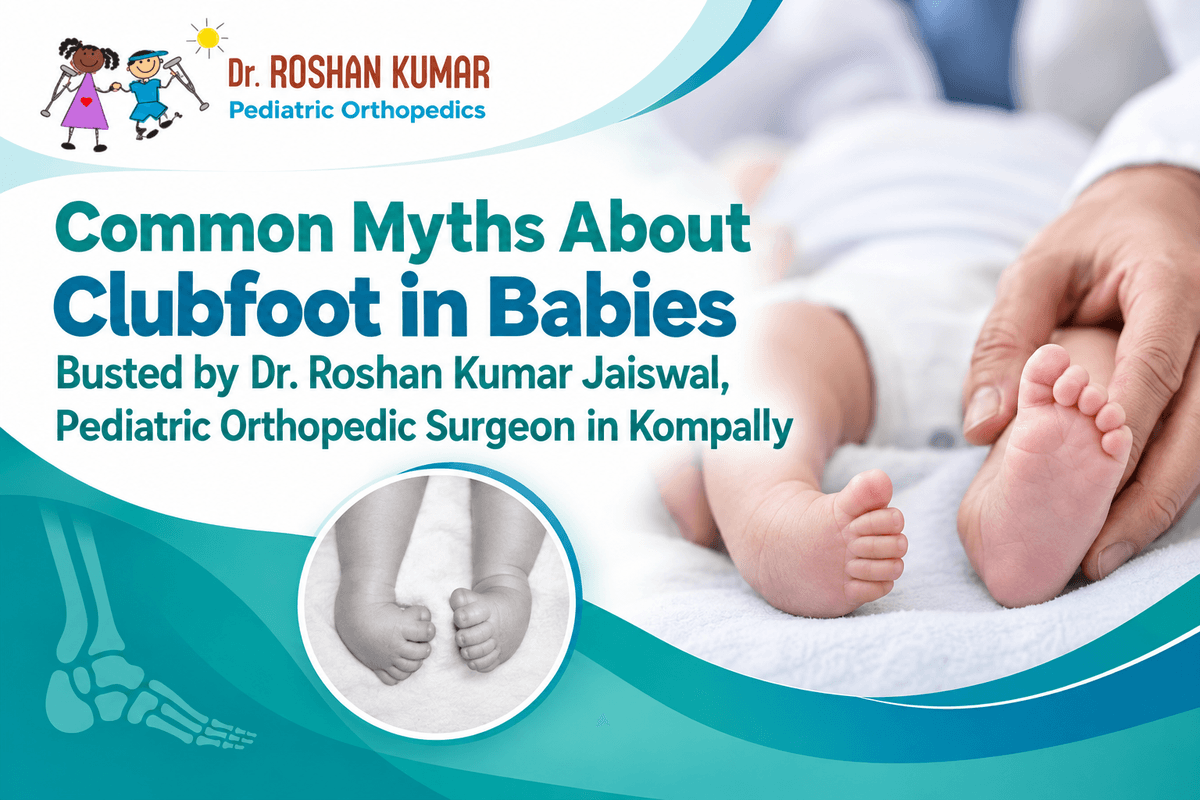
Common Myths About Clubfoot in Babies Busted by Dr. Roshan Kumar Jaiswal, Pediatric Orthopedic Surgeon in Kompally
When Your Newborn Is Diagnosed with Clubfoot — Fear Is the First Reaction, But It Shouldn't Be the Last
The moment a doctor points to a newborn's turned-in foot and says "clubfoot," a parent's world shifts. For many families in Kompally and the surrounding areas of North Hyderabad, this diagnosis arrives wrapped in layers of myth, misinformation, and misplaced guilt. Some grandparents whisper that the mother did something wrong during pregnancy. Others insist that major surgery is inevitable, or worse — that the child will never walk normally.
These myths are not just incorrect. They are dangerous. They delay treatment, breed unnecessary shame, and rob children of the best possible outcomes. Although painless in infancy, untreated clubfoot can lead to walking difficulties, imbalance, and long-term physical limitations. The good news? With timely intervention from a skilled Pediatric Orthopedic Surgeon in Kompally, clubfoot is highly treatable — and most children go on to live completely normal lives.
Dr. Roshan Kumar Jaiswal, Pediatric Orthopedic Surgeon in Kompally, is here to set the record straight.
The Truth About Clubfoot: What Every Parent in Kompally Must Know
Clubfoot, medically known as Congenital Talipes Equinovarus (CTEV), is far more common than many parents realise. Around 150 babies are born with clubfoot in India every day, making it an important congenital condition that requires timely diagnosis and treatment. Approximately 50% of cases of clubfoot affect both feet.
The single most important truth is this: clubfoot is correctable. With proper treatment, more than 95% of children can achieve full correction and mobility. Clubfoot is correctable with the Ponseti method — a highly effective, low-cost innovative medical intervention that results in complete correction and full functionality in nearly all cases.
The vast majority of cases are diagnosed at birth and occur in otherwise healthy babies. The foot deformity does not reflect the child's overall health, intelligence, or future potential. The outlook for children who are born with a clubfoot and undergo Ponseti treatment, including the complete bracing phase, is excellent — they can be expected to wear normal shoes, participate in sports, and have every opportunity for a happy and productive life.
5 Clubfoot Myths — Busted
❌ Myth 1: "The Mother Is to Blame"
This is one of the most harmful myths heard in clinics across India, including here in Kompally. The reason for clubfoot is unknown till today, so no one should be blamed. The mother cannot be blamed if the child has clubfoot. Researchers don't know the exact cause of clubfoot — it's most likely a combination of genetics and environment. No act, food, posture, or behaviour during pregnancy causes clubfoot. Blaming the mother is scientifically baseless and emotionally cruel.
❌ Myth 2: "Surgery Is the Only Option"
Many parents in Kompally are told that surgery is the only cure. This is simply not true. The Ponseti method is the standard of care for treating infants born with clubfoot. It makes orthopedic surgery — except a minor tendon procedure — unnecessary. Surgery disrupts joints and spoils the foot, and many children suffer pain, stiffness, and relapse after very expensive surgery.
❌ Myth 3: "Wait Until the Child Is 3–4 Years Old to Begin Treatment"
Delaying treatment is one of the most damaging decisions a parent can make. Children born with clubfoot should start treatment soon after birth, preferably within the first three months. The child's deformed foot should be corrected before the child starts walking. When treatment begins within the first three weeks after birth, most infants grow up without any physical symptoms, pain, or walking dysfunction due to clubfoot.
❌ Myth 4: "Clubfoot Means My Child Will Never Walk Normally"
This myth causes immeasurable heartbreak — and it is entirely false. The Ponseti method — a series of gentle manipulations and serial casting beginning in the first weeks of life — has improved clubfoot treatment with success rates exceeding 95%. Most children treated with the Ponseti method develop feet that are functional, pain-free, and nearly normal in appearance. Children treated promptly run, play, and participate in sports just like their peers.
❌ Myth 5: "If No One in My Family Had Clubfoot, It Can't Happen Again"
Many parents assume clubfoot is random and cannot recur. In reality, there appears to be a hereditary component to this birth defect, given that the risk of developing congenital clubfoot is 25% when a first-degree relative is affected. Conversely, having a family history of clubfoot may increase the risk, but the condition can also occur without any known family history. Genetic counselling after a clubfoot diagnosis is always advisable.
How Dr. Roshan Kumar Jaiswal Treats Clubfoot at His Kompally Clinic
At Dr. Roshan Kumar Jaiswal's Pediatric Orthopedic practice in Kompally, the treatment approach is rooted in evidence-based medicine, compassionate care, and parent education. Serving families from Kompally, Medchal, Shamirpet, Alwal, and surrounding areas of North Hyderabad, Dr. Jaiswal provides end-to-end clubfoot management including:
- Early diagnosis and Pirani scoring — to accurately grade severity from the first visit
- Ponseti serial casting — gentle, weekly manipulation and casting to progressively correct foot position
- Percutaneous Achilles tenotomy — a minor outpatient procedure performed when needed, typically around 8–10 weeks of age
- Foot Abduction Brace (FAB) fitting and follow-up — the key to long-term success is strict compliance with the foot abduction brace (boots and bar) for 4–5 years after casting to prevent recurrence
- Parental counselling and education — because an informed parent is the most powerful ally in a child's recovery
When initiated during infancy, the position of the foot is usually corrected within six to eight weeks. Dr. Jaiswal's clinic in Kompally ensures that no family has to travel far for world-class paediatric orthopaedic care.
Evidence: The Numbers Behind the Results
The science behind clubfoot treatment is reassuring and robust.
- India registers almost 50,000 cases of clubfoot children every year.
- The Ponseti method is currently the gold standard of CTEV treatment and has a more than 90% success rate, adopted worldwide as the primary technique.
- Newborns treated with the Ponseti method experience fewer long-term complications than those treated surgically.
- Following the Ponseti protocol, success rates of 95.45% have been achieved.
- Approximately 80% of individuals with clubfoot present as isolated cases — meaning the vast majority of babies are otherwise completely healthy.
- With a pediatric orthopedic surgeon's help and your commitment to following the treatment plan, clubfoot doesn't have to be a permanent deformity. Treatment can help prepare your baby to walk, run, jump, and skip through childhood.
These are not just statistics. For families in Kompally who walk through Dr. Jaiswal's clinic doors anxious and overwhelmed, these numbers represent real hope.
Frequently Asked Questions (FAQ)
Q1. At what age should I bring my baby for clubfoot treatment in Kompally?
As early as possible — ideally within the first 2 weeks of birth. Most cases are identified during routine newborn examinations, allowing treatment to begin early when a baby's bones and joints are most flexible. When treatment begins within the first few weeks of life, the soft tissues and bones respond quickly to gentle correction. If you are in Kompally or nearby areas like Medchal or Alwal and have just received a clubfoot diagnosis, consult Dr. Roshan Kumar Jaiswal immediately — do not wait.
Q2. Is the Ponseti casting method painful for my baby?
No — the Ponseti method is gentle and designed specifically for infants. Treatment involves a series of weekly casts to gently reposition the feet and a simple outpatient procedure to release the Achilles tendon, followed by use of a foot abduction brace worn for 4–5 years while sleeping to maintain the correction and reduce the chance of relapse. Babies tolerate the process well, and parents play an active, supportive role throughout.
Q3. Can clubfoot come back after treatment?
Relapse is possible but preventable with consistent brace use. In a small percentage of children, clubfoot can relapse. The most common cause is that braces were not worn as long as necessary. If clubfoot returns, doctors often start the Ponseti method again with excellent outcomes. Regular follow-up with your Pediatric Orthopedic Surgeon in Kompally is essential.
Q4. Does my child in Kompally need major surgery for clubfoot?
Almost certainly not, if treatment starts early. It is extremely rare for a child treated with the Ponseti method to need a joint release surgery. The only minor procedure typically involved is a small Achilles tendon release, which is performed as a painless outpatient procedure. Families in Kompally, Shamirpet, and Medchal can access this complete non-surgical treatment pathway at Dr. Jaiswal's clinic.
Q5. Will my child born with clubfoot be able to run and play sports normally?
Yes — with early, proper treatment, absolutely. When treatment begins within the first few weeks of life, the soft tissues and bones respond quickly to gentle correction. Most children who receive prompt clubfoot treatment develop normal mobility and participate fully in everyday activities. Many athletes around the world were born with clubfoot and went on to compete at the highest levels — early intervention is the key.
Reviewed and authored by Dr. Roshan Kumar Jaiswal, Pediatric Orthopedic Surgeon, Kompally. This blog is intended for informational purposes only and does not substitute for a medical consultation.
Visit Us
Visit Dr Roshan Kumar Jaiswal for trusted, compassionate care. We're here for you and your family.
Dr Roshan Kumar Jaiswal
Kompally
Phone: +919542904584
Website: www.drroshanchildortho.com/
Google Maps: https://www.google.com/maps/place/?q=place_id:ChIJO7gwI0CZyzsRTxp9wAaOdWI
Email: jaiswal_roshan02@yahoo.co.in