Treated by Dr. Roshan Kumar Jaiswal
Angular deformities are abnormal sideways or rotational deviations in the alignment of bones, particularly affecting the legs and arms in children in Secunderabad. These conditions can range from mild bowlegs or knock-knees to severe deformities that impact function, gait, and long-term joint health. Early evaluation and treatment by Dr. Roshan Kumar Jaiswal, a specialized Pediatric Orthopedic Surgeon, ensures optimal correction and prevents future complications.
An outward curvature of the legs at the knees, creating a bowed appearance. Common in infants and toddlers, most cases resolve naturally by age three, but persistent or severe bowing requires evaluation for underlying conditions like Blount's disease or rickets.
An inward angulation of the knees where the knees touch while the ankles remain apart. Typically peaks between ages 3-4 years and gradually corrects by age 7-8, though severe cases or those persisting beyond this age may require intervention.
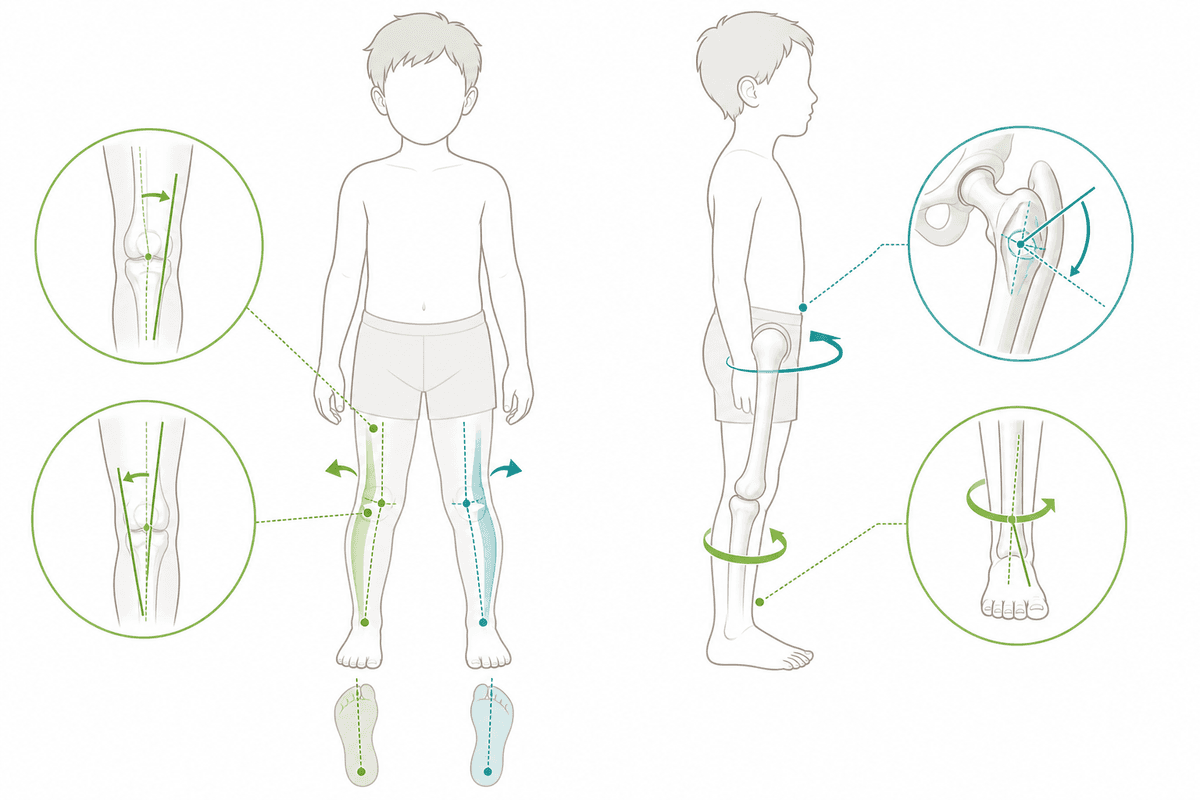
Rotational deformities where the tibia or femur is twisted along its long axis, causing in-toeing or out-toeing gait patterns. These can be internal or external rotations and may affect one or both limbs, impacting walking mechanics and appearance.
Multiple factors can contribute to the development and progression of this condition.
Angular deformities develops gradually. Recognising symptoms early gives you more treatment options.
From conservative to surgical — we always start with the least invasive option first.
A structured, patient-first approach from first visit to full recovery.
Dr. Roshan Kumar Jaiswal conducts a thorough physical examination measuring limb alignment, joint mobility, and gait patterns, complemented by full-length standing radiographs to precisely quantify the deformity and identify underlying causes.
Based on the child's age, severity of deformity, growth potential, and underlying etiology, Dr. Jaiswal develops an individualized treatment strategy, discussing all options with the family and setting realistic expectations for correction timelines.
When surgery is indicated, Dr. Jaiswal employs advanced techniques including computer-assisted planning, minimally invasive approaches, and state-of-the-art fixation methods to achieve accurate correction while minimizing tissue trauma and recovery time.
Post-treatment monitoring includes regular clinical and radiographic assessments to track correction progress, physical therapy guidance to restore strength and function, and timely implant removal when appropriate, ensuring optimal long-term outcomes.
What to expect at each phase of recovery.
Initial healing focuses on wound care, pain management, and protected weight-bearing. For guided growth, children often return to activities within 2-3 weeks. Osteotomy patients may require casting or bracing with gradual weight-bearing progression under physiotherapy guidance.
Guided growth patients undergo regular monitoring as correction occurs gradually. Osteotomy patients progress from protected to full weight-bearing, begin strengthening exercises, and work on restoring normal gait patterns. Radiographs track bone healing and alignment improvement.
Once adequate correction is achieved in guided growth cases, implants are removed through a brief outpatient procedure. Final alignment is verified, and patients are monitored through remaining growth years to ensure maintenance of correction and normal joint development.
Successful treatment achieves mechanical axis restoration within normal ranges, eliminating visible deformity and creating symmetric limb appearance with balanced joint loading during weight-bearing activities.
Correction of angular deformities normalizes walking patterns, eliminates compensatory movements, and enables full participation in sports and physical activities without limitations or discomfort from malalignment.
Early correction prevents abnormal joint stress distribution that leads to premature cartilage wear, significantly reducing the risk of early-onset osteoarthritis in the knees, hips, and ankles during adulthood.
Beyond physical correction, treatment improves children's confidence, eliminates self-consciousness about appearance, and ensures they can participate fully in age-appropriate activities without functional restrictions or social concerns.
Untreated significant angular deformities lead to progressive joint degeneration, with abnormal stress concentration causing early osteoarthritis in the knees, hips, and ankles. Functional limitations worsen over time, including difficulty with walking, running, and daily activities. In severe cases, the deformity progresses, becomes increasingly rigid, and requires more complex surgical correction with less predictable outcomes if addressed later in life.
Parents should seek evaluation if their child's bowlegs persist beyond age 2-3 years, knock-knees continue past age 7-8 years, or if there is asymmetric deformity affecting only one leg. Immediate consultation with Dr. Roshan Kumar Jaiswal is warranted if the child experiences pain, progressive worsening of the deformity, difficulty walking, or if there are concerns about abnormal gait patterns. Early assessment enables timely intervention during optimal growth phases for the best outcomes.
Early treatment means more options and better outcomes. Book a consultation to understand your condition and explore the right path forward.
Consult Roshan Kumar Jaiswal for Angular deformities at any of these 9 centres — pick the one nearest you.